

Introduction: A Continent That Trades to Live
Europe has always been a crossroads—an intricate patchwork of nations, cultures, languages, and coastlines perched at the intersection of Asia, Africa, and the Atlantic world. Yet beneath its celebrated art, cities, railways, and historical richness lies a quieter, powerful truth: Europe lives and breathes through global trade.
More than any other major region, Europe’s prosperity, security, and everyday functioning depend on the ability to import what it lacks, export what it excels at, and maintain frictionless exchange with dozens of markets across the world. From the energy that powers its factories to the smartphones in its pockets and the cheeses on its tables, global trade is not merely an economic preference—it is the foundational structure supporting the European way of life.
This article explores why Europe is so unusually dependent on global trade, how this dependence developed, what advantages and vulnerabilities it creates, and how Europe might navigate the next decades in a world where trade is being reshaped by geopolitics, technology, and climate pressures.
We’ll take the long view—from geography and history to energy, labor markets, industrial specialization, economic integration, and global supply chains—to understand why Europe cannot simply “turn inward,” even when the world feels politically stormy.
1. Geography: A Small Peninsula With Big Needs
Europe is not only small compared with other continents—it is resource-poor in critical categories.
1.1 Size Constraints and Resource Distribution
Europe is the second-smallest continent, and much of its territory lacks the large-scale raw materials that power heavy industry in other regions:
- Limited oil and gas (except for some North Sea production)
- Modest mineral reserves compared with Africa, Latin America, or Australia
- Low-cost agricultural capacity constrained by land area
- Few sources of rare earths and strategic metals
Europe consumes far more energy and industrial inputs than it can produce domestically, which locks it into global supply chains. A continent with high population density and advanced industrialization inevitably leans outward to satisfy demand.
1.2 Coastlines That Encourage Connection
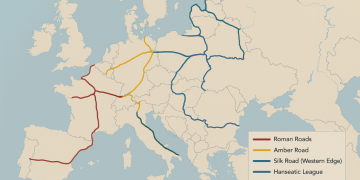
Europe’s famously fractal coastline—fjords, peninsulas, islands, navigable inland rivers—makes it physically optimized for maritime trade. Nearly every part of Europe is close to the sea, and the sea has always been Europe’s commercial highway.
When your geography favors shipping, you naturally become outward-facing.
1.3 The Neighborhood Effect
Europe sits adjacent to regions rich in resources:
- Energy from the Middle East and North Africa
- Metals from Africa
- Agricultural goods from the Black Sea region
- Industrial goods from Asia
It’s cheaper and simpler for Europe to import than to recreate these industries domestically.
Geography did not make global trade an option for Europe.
It made global trade a necessity.
2. History: A Legacy Built on Exchange
Europe’s dependency on trade isn’t new—it is historical and structural.
2.1 The Age of Exploration and the Birth of Global Networks
From the 15th century onward, European states built economic systems connected to global flows of:
- Spices
- Silver and gold
- Textiles
- Agricultural commodities
- Enslaved labor
- Manufactured goods
These flows funded European urbanization, industrialization, and military power. Europe grew wealthy by building and controlling global trade systems. As those systems matured, Europeans developed industries and lifestyles that assumed constant international exchange.
Trade became a habit, then an expectation, and finally a structural cornerstone.
2.2 Industrialization: Importing Resources, Exporting Products
Europe’s industrial revolutions intensified the pattern.
Factories needed:
- Coal
- Iron
- Rubber
- Cotton
- Chemically important minerals
- Oil
Many of these were unavailable in Europe in the volumes needed for mass manufacturing. Thus, Europe refined a global model of:
import raw materials → manufacture finished goods → export worldwide
Even today, Germany’s manufacturing powerhouse, Italy’s fashion industry, France’s aerospace sector, and the Netherlands’ logistics hubs are built on this same formula.
2.3 A Post-War Vision Linked to Trade
After World War II, European leaders deliberately designed the continent to avoid future conflicts through economic integration. The European Coal and Steel Community (ECSC), then the European Economic Community (EEC), and eventually the European Union (EU) bound economies together.
The logic:
Countries that depend on each other for trade have fewer incentives to fight.
Thus, Europe did not merely embrace trade for economic reasons—it embraced trade for peace and political stability.
3. The European Union: The World’s Largest Trading Bloc
Europe’s dependency on global trade is amplified by the internal dynamics of the EU.
3.1 The Single Market: Specialization Within a Large Space
The EU single market—over 440 million consumers—encourages each country to specialize in what it does best:
- Germany: precision manufacturing, machinery, automotive
- France: aerospace, luxury goods, agriculture
- Italy: design, high-tech materials, fashion, specialized machinery
- Netherlands: logistics, agri-tech, pharmaceuticals
- Sweden: green technology, industrial equipment
- Spain: agrifood, automotive components
Specialization creates high productivity, but also high interdependence—both within Europe and beyond.
3.2 The Euro: A Currency Built for Trade
The euro facilitates trade by reducing currency risk, lowering transaction costs, and simplifying cross-border investment.
However, it also means that European competitiveness depends on:
- External export markets
- Global supply chains
- Stable international financial relationships
European economies aren’t built to be autarkic; they are built to be plugged into a globalized system.
3.3 Regulatory Power With Global Reach
Europe exports more than goods—it exports rules.
EU standards influence global markets in:
- Data protection
- Food safety
- Chemical regulation
- Environmental protection
- Product design
This is sometimes called “The Brussels Effect.”
Europe gains enormous geopolitical influence from global trade because trade spreads its regulatory framework worldwide.
4. Energy: The Most Critical Dependency of All
Europe is profoundly energy-short.
4.1 Fossil Fuels: A Structural Deficit
Europe imports:
- Over 95% of its crude oil
- A significant percentage of natural gas
- Most of its coal (though decreasing)
Energy is essential for:
- Transport
- Chemicals
- Manufacturing
- Heating
- Power generation
No matter how advanced Europe becomes, it cannot power its economy without international energy flows.
4.2 Renewable Transition: Still Requires Trade
Even green technology depends on imports:
- Solar panels from Asia
- Critical minerals from Africa and South America
- Batteries from East Asia
- Rare earth elements from China
- Manufacturing parts for wind turbines
Europe’s green transition actually increases some types of global dependence.
4.3 Energy Infrastructure Ties
Pipelines, LNG terminals, and grid interconnections bind Europe to:
- Norway
- North Africa
- Middle East suppliers
- U.S. LNG producers
- Azerbaijan and the Caucasus region
Energy security and trade security are nearly the same concept in Europe.
5. Industrial Structure: High Skill, High Value, High Complexity
Europe specializes in industries that thrive only within deeply interconnected global supply chains.
5.1 Advanced Manufacturing Interdependence
European exports rely on complex, multi-country production stages:
- German cars assembled using electronics from East Asia
- French aircraft built using materials from the U.S. and composites from Japan
- Dutch semiconductor equipment requiring components from dozens of countries
- Italian machinery incorporating Swiss precision parts
- Spanish automotive factories fed by global logistics networks
A disruption anywhere—Japan, Taiwan, the U.S., China—can halt European manufacturing lines within days.
5.2 Why Europe Can’t Make Everything It Needs
Producing everything domestically would require enormous:
- Cost increases
- Energy inputs
- Mining expansion
- Labor force expansion
- Environmental sacrifices
Europe’s regulatory environment and high labor costs make broad-spectrum domestic production unrealistic.

Thus, specialization makes Europe richer—but also more trade-dependent.
5.3 Services and Intellectual Exports Still Rely on Trade
Even Europe’s globally dominant service industries, such as:
- Finance
- Tourism
- Higher education
- Design
- Engineering
- Consulting
depend on:
- Open borders
- International capital flows
- Student mobility
- Cross-border business agreements
- Standardized regulations
Europe’s “soft power” economy is also a trade economy.
6. The Demographic Angle: Aging and Labor Shortages
Europe’s population is aging rapidly, and birth rates remain low. This demographic structure intensifies trade dependence in two ways.
6.1 Importing What the Workforce Cannot Produce
Older populations:
- Buy more goods
- Need more medical equipment
- Require more pharmaceuticals
- Consume more energy
- Demand more imported labor-intensive goods
Europe cannot produce all of this domestically with a shrinking workforce.
6.2 Exporting High-Value Goods to Support Welfare States
Europe’s strong social welfare systems—pensions, healthcare, public services—are funded by a productive, export-oriented economy. Maintaining these systems requires:
- High tax revenues
- Strong industrial exports
- Surplus-generating sectors
If Europe’s exports falter, funding its welfare systems becomes difficult.
6.3 Immigration: A Human Form of Trade
Labor mobility within the EU and immigration from beyond are forms of economic exchange. Europe’s demographic stability depends on:
- Foreign workers
- International students
- Migrant entrepreneurship
This too is a form of global interdependence.
7. Intra-European Trade Is Still Global Trade
Many analyses forget that Europe’s internal trade is also part of the global system.
7.1 The EU as a Network, Not an Island
European factories and farms are intricately connected across borders:
- German cars assembled with Polish parts shipped through Dutch ports
- French food products using Spanish ingredients packaged in Belgium
- Czech electronics reliant on Italian machinery sourced from global suppliers
The EU behaves like a single massive supply chain—one that depends on worldwide inputs.
7.2 Export-Driven Regional Economies
Key regions that rely heavily on global demand:
- Bavaria (automotive machinery)
- Northern Italy (industrial equipment)
- Catalonia (chemicals, pharma)
- Île-de-France (luxury goods, aerospace)
- Flanders (logistics)
These hubs thrive because they export far beyond Europe.
7.3 The EU’s Open Market Philosophy
European integration is tied to openness. The Union actively promotes:
- Free trade agreements (FTAs)
- Investment treaties
- WTO participation
- Regulatory harmonization
Europe is not merely part of the global trade system—it is an architect of it.
8. The Consumer Dimension: A Taste for the World
European citizens enjoy lifestyles that are only possible through global trade.
8.1 Food Culture Dependent on Imports
Europe imports:
- Coffee
- Tea
- Cocoa
- Spices
- Citrus fruit (Mediterranean produces some but not enough)
- Nuts
- Tropical fruits
- Fish from distant waters
- Wine production inputs (barrels, stoppers, yeasts) often sourced globally
Constant culinary curiosity keeps trade flowing.

8.2 Tech Consumption
European consumers demand:
- Smartphones
- Laptops
- Data centers
- Smart appliances
Nearly none of these can be manufactured entirely in Europe.
8.3 Fashion, Luxury, and Global Demand
European luxury houses rely on:
- Asian markets for sales
- Global materials (silk, leather, dyes)
- International tourists
- Worldwide logistics
Even industries where Europe is strongest rely on foreign supply and customers.
9. Logistics: Europe’s Superpower
Europe punches above its weight in logistics, ports, and global connectivity.
9.1 World-Class Ports
Europe hosts some of the world’s busiest ports:
- Rotterdam
- Antwerp
- Hamburg
- Valencia
These ports make Europe a primary gateway to global markets.
9.2 Cross-Continental Rail Links
Modern rail links connect Europe to:
- China (via the Silk Road rail routes)
- Central Asia
- The Middle East (via Turkey)
Intercontinental trade flows through European hubs.
9.3 Air Cargo Dominance
Airports like Frankfurt, Schiphol, and Charles de Gaulle move enormous volumes of high-value goods daily.
Connectivity reinforces dependence.
10. Vulnerabilities: When the World Sneezes, Europe Catches a Cold
Europe’s reliance on global trade also creates risks.
10.1 Supply Chain Fragility
Disruptions in:
- East Asian semiconductor plants
- Suez Canal chokepoints
- African mining regions
- U.S.-China tensions
can quickly disrupt European industry.
10.2 Energy Shocks
Europe is highly exposed to:
- Price spikes
- Geopolitical tension
- Pipeline shutdowns
- LNG supply constraints
Energy dependence can become political vulnerability.
10.3 Strategic Dependency Concerns
Europe relies heavily on external suppliers for:
- Rare earths
- Pharmaceuticals
- Fertilizers
- Electronics
- Green tech components
This has triggered a major policy focus on “strategic autonomy.”
10.4 Competition From Rising Economies
Asia’s rapid industrial rise challenges Europe’s competitiveness in:
- High-value manufacturing
- Tech innovation
- Shipping dominance
Europe must compete globally to sustain its prosperity.
11. Advantages: Trade Is Also Europe’s Greatest Strength
While dependency brings risks, it also brings enormous benefits.
11.1 High Living Standards
Europe enjoys:
- High incomes
- World-class healthcare
- Excellent transportation
- Cultural richness
- Technological sophistication
These achievements are built on a globally interconnected economy.
11.2 Leadership Through Standards
Europe sets global rules in:
- Climate targets
- Consumer safety
- Digital rights
Its regulatory influence is an asset derived from the size and openness of its markets.
11.3 Innovation Fueled by Diversity
Access to global ideas, talent, and products boosts European creativity and competitiveness.
11.4 Peace Through Prosperity
Trade interdependence helps maintain European peace and political cooperation.
12. The Future: Can Europe Remain a Global Trading Power?
The world is shifting:
- U.S.–China rivalry
- Supply chain reconfiguration
- AI-driven manufacturing
- Climate pressures
- Security concerns
So what does the future hold for Europe?
12.1 Strategic Autonomy Without Isolation
Europe aims to reduce certain dependencies—especially in:
- Energy
- Raw materials
- Semiconductors
- Critical pharmaceuticals
But the goal is selective rebalancing, not autarky.
12.2 Friendshoring and Regionalization
Europe will deepen trade with:
- The U.S.
- Canada
- Japan
- South Korea
- India
- African partners
- Latin America
Expect a gradual diversification away from single-source reliance.
12.3 Reindustrialization Through Green and Digital Transitions
Europe seeks leadership in:
- Green hydrogen
- Electric vehicles
- AI-driven industry
- Clean tech
- Sustainable manufacturing
These transitions will require even more global trade before they require less.
12.4 Energy Independence Will Shift, Not Eliminate, Trade Flows
Future energy trade will involve:
- Hydrogen imports
- Lithium and battery components
- Wind turbine materials
- Solar supply chains
In short: trade will evolve, not shrink.
13. Conclusion: Europe Trades Because It Must—And Because It Can
Europe is dependent on global trade because:
- Its geography limits natural resources
- Its history built global networks
- Its economy specializes in high-value, trade-intensive industries
- Its energy system relies on external suppliers
- Its demography reduces domestic production capacity
- Its political union thrives on openness
- Its consumers expect global diversity
- Its infrastructure is built for connectivity
This dependence is not a weakness by default—it’s a structural feature that has made Europe prosperous, stable, and influential.
Europe could not withdraw from global trade without fundamentally altering its society, economy, and identity. And most Europeans would not want to.
Global trade is not just something Europe participates in.
It is something Europe was designed for.
And that design continues to define the continent’s past, present, and future.