









Asia Pacific is a region of breathtaking diversity—of cultures, ecosystems, coastlines, and climates. It is also, unfortunately, a global hotspot for climate vulnerability. From sprawling megacities to remote archipelagos, from dense tropical rainforests to high-altitude plateaus, the region hosts both extraordinary natural riches and extraordinary risk. Rising sea levels threaten island nations, extreme heat endangers millions in South Asia, bushfires and coral bleaching destabilize Australia’s natural equilibrium, and typhoons grow stronger in Southeast Asia’s warming seas.
The question—“How Can Asia Pacific Mitigate the Effects of Climate Change?”—is not merely academic. It is existential. It is practical. And it is urgent.
This essay explores the pathways—economic, technological, ecological, political, and social—that can shape Asia Pacific’s climate-resilient future. While broad in scope, the article also presents insights in a lively and readable style, with a strong professional foundation. Think of it as both an expert roadmap and an engaging journey through the strategies most capable of reshaping the region’s climate destiny.
1. Understanding the Scale and Specificity of the Challenge
Asia Pacific’s climate challenges are not evenly distributed across its subregions. Instead, they reflect a combination of geography, population density, development patterns, and economic structure.
1.1 Rising Seas, Sinking Cities
Jakarta, Manila, Bangkok, and Ho Chi Minh City are among the world’s most vulnerable megacities to sea-level rise. Many are built on soft delta land, sinking due to groundwater extraction while seas rise around them. Mitigation here is not optional—it is survival.
1.2 Extreme Heat and Urbanization
Some South Asian cities are pushing the limits of human heat tolerance. Urban heat islands, fast urbanization, and insufficient green infrastructure amplify danger. Heat waves in India, Bangladesh, and Pakistan are no longer rare anomalies—they are becoming seasonal norms.
1.3 Ecosystem Loss and Climate Feedback
Asia Pacific contains irreplaceable ecosystems: coral reefs, mangroves, peatlands, primary rainforests. Their damage accelerates warming, which in turn accelerates their damage—a vicious cycle that demands urgent intervention.
1.4 Energy Demand Growth
Asia Pacific accounts for a vast portion of global future energy demand. Industrialization, electrification, and rising living standards can either deepen the climate crisis or spearhead a new clean-energy era.
Understanding this landscape is essential. Climate mitigation strategies must be tailored—not copied, not imported blindly, but adapted creatively to each nation’s geography and socio-economic structure.
2. Transforming Energy Systems: Asia Pacific’s Greatest Leverage Point
Decarbonizing energy is the region’s most powerful climate-mitigation lever. Demand is high, growth is fast, and potential is enormous.
2.1 The Shift to Renewable Power
Asia Pacific is already home to the world’s largest renewable installations:
- Frontier solar fields in China, India, and Australia
- Rapid wind deployment across coastal and inner China
- Geothermal strongholds in Indonesia and the Philippines
- Hydropower giants in Southeast Asia
- Emerging offshore wind in Taiwan, Japan, and Vietnam
Scaling renewables further requires:
- modernized grids
- regional power interconnections
- large-scale battery storage
- streamlined permitting processes
- stable energy policy frameworks
Renewables are no longer a noble aspiration; they are an economic imperative.
2.2 Harnessing the Green Hydrogen Wave
For industry, heavy transport, chemicals, and steelmaking, green hydrogen could reduce Asia Pacific’s hard-to-abate emissions. Australia is positioning itself as a hydrogen superpower, while Japan and South Korea are pushing hydrogen technology.
To succeed, the region needs:
- consistent hydrogen certification standards
- investment in electrolysis technologies
- port infrastructure upgrades
- cross-border hydrogen trade routes
Hydrogen is not a silver bullet, but a crucial arrow in the climate-action quiver.
2.3 Phasing Out Coal—The Region’s Most Complex Challenge
Asia Pacific burns more coal than the rest of the world combined. Transitioning away requires a mix of:
- just-transition policies for workers
- early-retirement financing for coal plants
- domestic energy-security plans
- compensation models for stranded assets
It is politically tough, but economically and environmentally necessary.
3. Building Climate-Resilient Cities
Urbanization is the beating heart of Asia Pacific’s economic rise—and its climate vulnerabilities. Mitigation here is about redesigning cities for both sustainability and livability.
3.1 Green Architecture and Building Efficiency
Better buildings reduce energy demand massively. Key strategies include:
- passive cooling architecture inspired by local traditions
- high-performance insulation and glazing
- rooftop solar integration
- building-management digitalization
Asia Pacific’s rapid construction turnover gives it a unique advantage: new buildings can incorporate green design from the start.
3.2 Sustainable Mobility
Cities like Singapore, Seoul, and Tokyo offer regional models for low-carbon transport. To replicate success, cities must invest in:
- electric buses and micro-transit fleets
- bike lanes suited to dense Asian cities
- congestion pricing and integrated transit cards
- electrified logistics hubs for last-mile delivery
With transport emissions rising fast, mobility reform is urgent.
3.3 Cooling Cities with Nature
To counter extreme heat:
- urban forests
- waterfront parks
- vertical greenery
- reflective surfaces
- permeable pavements
These solutions are inexpensive, scalable, and multi-benefit.
4. Protecting and Restoring Natural Ecosystems
Asia Pacific’s ecosystems are climate assets. Preserving them is not just conservation—it’s mitigation.

4.1 Mangroves, Coral, and Coastal Ecosystems
Mangroves sequester carbon at extraordinary rates and protect coastlines from tropical storms. Restoring them can generate:
- carbon-offset revenue
- fisheries recovery
- community-based ecotourism
Coral reefs require aggressive marine-protection policies and climate-resilient coral restoration.
4.2 Forests and Peatlands
Millions of hectares of tropical forests in Indonesia, Malaysia, and Papua New Guinea act as a global carbon sink. Preventing deforestation, illegal logging, and peatland drainage is among the most impactful mitigation strategies worldwide.
4.3 Agricultural and Land-Use Transformation
Asia Pacific farmers face climate stressors daily. Solutions include:
- climate-smart irrigation
- drought-resistant crop strains
- precision agriculture
- regenerative farming
- agroforestry
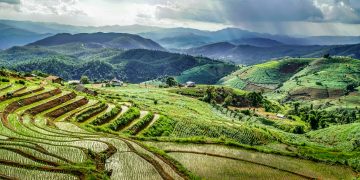
Reducing agricultural methane (especially rice paddies and livestock) is another essential step.
5. Leveraging Technology and Innovation
Technological innovation is one of Asia Pacific’s strongest assets.
5.1 AI-Optimized Energy Efficiency
AI can manage:
- industrial energy use
- smart-grid operations
- predictive maintenance in power plants
- real-time emissions monitoring
AI-enhanced energy efficiency is one of the cheapest mitigation opportunities.
5.2 Satellite and Sensor Monitoring
Remote sensing helps:
- track forest loss in real time
- monitor glaciers in the Himalayas
- predict extreme weather impacts
- identify methane leaks
Data transparency empowers better environmental governance.
5.3 Carbon Capture Where Unavoidable
Though not a primary solution, carbon capture can help decarbonize specific sectors like cement or chemicals when alternatives don’t yet exist. Asia Pacific industrial hubs are testing carbon-capture clusters to reduce cost and scale deployment.
6. Regional Cooperation: The Secret Weapon
No nation in Asia Pacific can mitigate climate change alone.
6.1 Regional Energy Grids
Cross-border electricity trade could:
- balance renewable supply
- reduce blackout risks
- lower electricity costs
Imagine solar from Australia feeding Southeast Asia by day and wind from Mongolia spinning turbines at night powering the region—this is the vision of an Asia Super Grid.

6.2 Shared Climate Standards
Harmonizing:
- carbon markets
- green finance rules
- renewable-energy certifications
would unlock trillions in climate investment.
6.3 Humanitarian and Disaster-Response Coordination
The Pacific Islands, Philippines, Bangladesh, and others face increasingly violent storms. Shared disaster-response capabilities and early-warning systems save lives and enable quicker recovery.
7. Mobilizing Climate Finance
Mitigation requires money—lots of it.
7.1 Green Bonds and Transition Finance
Asia Pacific is already a global leader in green bonds. Expanding these markets helps fund:
- renewable energy
- smart infrastructure
- ecological restoration
Transition finance, meanwhile, helps high-emitting sectors decarbonize without shutting down overnight.
7.2 Private-Sector Innovation
Technology companies, banks, and multinational corporations in the region are driving ambitious climate strategies. Leveraging private finance can speed up climate tech scale-up and cross-border investment.
7.3 Climate-Resilient Infrastructure Funds
These funds support long-term adaptation and mitigation projects—roads, ports, buildings, green grids, and climate-proof water systems.
8. Empowering Communities and Cultures
Climate mitigation is not just policy—it is culture.
8.1 Indigenous Knowledge
Indigenous communities in the Pacific, Southeast Asia, and Australia hold invaluable expertise in land stewardship, biodiversity management, and water conservation. Empowering them strengthens climate resilience.
8.2 Youth Climate Movements
Asia Pacific hosts one of the world’s most vibrant youth climate movements. Their activism influences policy, raises awareness, and drives societal change.
8.3 Education and Public Engagement
Climate-literate citizens help shift markets and politics. Schools, universities, and public campaigns should embed climate understanding into mainstream culture.
9. Industry Reinvention
Asia Pacific is a manufacturing powerhouse. Decarbonizing industry requires bold restructuring.
9.1 Clean Industrial Hubs
Industrial clusters can pool:
- renewable energy
- waste heat reuse
- water recycling
- carbon capture
These hubs can redefine global supply chains.
9.2 Low-Carbon Shipping and Ports
The region relies heavily on maritime trade. Ports can adopt:
- shore-side electrification
- green-methanol-ready terminals
- autonomous low-carbon ships
Shipping decarbonization has region-wide impact.
9.3 Electric and Sustainable Manufacturing
Electrifying manufacturing processes and improving circular-economy practices reduce emissions and dependence on raw materials.
10. The Pacific Islands: Frontline Leaders, Not Victims
Though they contribute little to global emissions, Pacific Island nations lead with bold climate diplomacy and innovative adaptation strategies. Their voices shape international climate agreements and moral guidance.
Strategies include:
- climate-resilient housing
- early-warning systems
- ocean-based climate solutions
- global advocacy for loss-and-damage funding
Their leadership must be amplified, not overlooked.
11. A Vision for Asia Pacific’s Climate Future
Mitigation is more than reducing emissions—it is about redesigning the region’s future in a way that is livable, prosperous, and equitable.
Imagine:
- Cities cooled by urban forests, powered by solar-wind hybrid grids
- Coral reefs returning to color
- Agriculture that regenerates soil instead of depleting it
- Clean-tech industries powering economies
- Regional electricity networks balancing renewable cycles
- Communities strengthened by local knowledge and digital innovation
This is not fantasy. It is within reach—if action accelerates today.
Asia Pacific’s climate story is not predetermined. It is a narrative in motion, shaped by policy, innovation, cooperation, and collective courage. The region has the talent, the technology, the natural resources, and the cultural resilience to lead the world in climate mitigation.
The question is no longer whether Asia Pacific can mitigate the effects of climate change.
The real question is how fast—and how boldly—it will choose to act.