







Introduction: A Region Built on Black Gold—But Why?
Say “Middle East,” and chances are that one of the first things that comes to mind is oil. The region’s petroleum wealth has shaped global politics, powered industrialization, fueled wars, and built glittering skyscrapers where once stood only sand and sun. But the story is far more complex, far more strategic, and far more misunderstood than the simple tale of “They have oil, so they export it.”
To understand the real story behind the Middle East’s oil dependency, we need to explore five dimensions:
- Geology – Why the Middle East ended up sitting on oceans of oil in the first place
- Colonial history & politics – How foreign powers shaped the region’s modern oil states
- Economics – Why oil became both a lifeline and a cage
- Society & culture – How fossil fuel wealth reshaped identity, labor, and daily life
- The future – How the region is struggling, and sometimes succeeding, at escaping the oil trap
Yes—oil made the Middle East powerful. But it also made it vulnerable. The true story is not one of endless advantage, but one of nations living under the constant pressure of a commodity that brings both wealth and instability.
Let’s dive into the real narrative behind the Middle East’s oil dependency: geological accident, imperial engineering, economic necessity, political leverage, and the ongoing quest for a post-oil future.
1. The Geological Jackpot: Nature’s Most Serendipitous Gift
Before politics entered the picture, the Middle East’s fate was shaped by events hundreds of millions of years ago.
Ancient Oceans, Perfect Conditions
Long before humans walked the earth—long before there even was a Middle East—this region was located under shallow, warm, nutrient-rich seas. Those seas generated astronomical amounts of plankton. When the organisms died, they sank to oxygen-poor waters that preserved the organic matter. Over millions of years, pressure and heat transformed those remains into hydrocarbons.
Then, nature performed its magic:
- Huge tectonic plates shifted, folding and trapping oil into reservoirs
- The region avoided glaciation, preserving the delicate oil-rich structures
- Porous rocks formed perfect natural storage tanks
- Impermeable layers capped the reservoirs, preventing leakage
In other words: the Middle East won the hydrocarbon lottery, geologically engineered to accumulate oil with remarkable efficiency.
Sweet, Shallow, Abundant
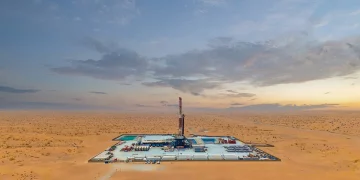
Not only does the Middle East have a lot of oil—it has fantastically easy-to-extract oil:
- Close to the surface
- Low sulfur (“sweet”)
- Vast, contiguous reservoirs
- Minimal refining complexity
- Lower production costs than nearly anywhere else on earth
Saudi Arabia’s Ghawar Field is so large it looks like a sci-fi megastructure—over 280 km long, holding billions of barrels.
Put simply, the region isn’t dependent on oil only because it wants to be—it’s because nature put more accessible oil here than almost anywhere else.
2. How Empires Turned Geology into Politics
Having the resource is only half the story. The other half begins in the early 20th century, when the industrializing world desperately needed fuel. As oil replaced coal, the Middle East suddenly transformed from “remote desert” to “strategic obsession.”
The Colonial Carve-Up: Lines Drawn for Oil
After World War I, European powers (especially Britain and France) divided the Ottoman Empire into artificial nation-states. Borders were drawn not around tribes or cultures, but around resources.
Certain states became “oil states” by design:
- Iraq was shaped partly to give Britain access to Mesopotamian oil fields
- Kuwait emerged as a British-protected oil enclave
- Saudi Arabia entered the scene through U.S. companies seeking exclusive drilling rights
- Iran became the site of British-controlled oil extraction (and later, CIA interference)
The modern Middle East map is not an organic product—it is an industrial blueprint.
Concessions and Control
In the early decades, the oil didn’t truly belong to the region. Western oil corporations controlled:
- Extraction
- Pricing
- Profits
- Infrastructure
- Shipping routes
Local rulers received royalties, but Western companies captured the real wealth.
The Middle East’s dependency on oil was engineered: foreign powers ensured that the region’s political and economic systems revolved around petroleum.
Nationalization: A Turning Point
Between the 1950s and 1970s, oil-producing countries took control of their national resources:
- Iran (before its 1953 coup)
- Iraq (1972)
- Saudi Arabia (gradual until 1980)
- Kuwait, Libya, Algeria, etc.
With nationalization came power—and with power came new challenges.
3. The Economics of Dependency: The Oil Curse Explained
Oil can enrich a nation, but it can also trap it.
The Paradox of Plenty
Economists call it the resource curse:
- Countries with abundant natural resources often experience slower long-term growth
- Economies become one-dimensional
- Governments grow dependent on oil revenue instead of taxation
- Citizens become dependent on government benefits
- Non-oil industries wither due to currency inflation (“Dutch Disease”)
The Rentier State Model
The Middle East pioneered the rentier state, a system where:
- The state earns income from resource rents, not citizens
- Citizens become clients of the state
- Political stability depends on distributing oil wealth
- Pressure for democracy decreases because the state doesn’t need taxpayers
This model explains why many Middle Eastern states remain authoritarian: oil wealth replaces the political bargain that creates participatory government in other regions.
Boom-Bust Cycles
Global oil prices swing wildly. This means:
- Gulf states often experience massive surpluses followed by deep deficits
- Infrastructure projects proceed in bursts
- Social benefits expand and contract with market cycles
The region’s entire economic rhythm is tied to a commodity it cannot control.
Why diversification is so difficult
Everyone agrees that Middle Eastern economies need to diversify—but several forces resist the change:
- Oil is too profitable compared to alternatives
- Bureaucracies are built around distributing oil wealth
- Labor markets rely heavily on foreign workers, making local innovation difficult
- Societies expect oil-funded welfare systems
- Leaders risk political instability if they reduce subsidies or raise taxes
The result? Progress happens, but slowly—and sometimes only after crisis.
4. How Oil Reshaped Society, Identity, and Culture
Oil didn’t just build skyscrapers. It reshaped traditions, demographics, and daily life across the region.
From Tribal Economies to Global Powerhouses
Before oil, the region’s economies ran on:
- Pearling
- Caravan trade
- Pastoralism
- Small-scale agriculture
These were fragile livelihoods, highly vulnerable to climate and global markets.
Oil changed everything:
- Cities like Dubai, Doha, and Riyadh exploded in size
- Nomadic populations settled into urban life
- Education systems expanded rapidly
- Healthcare improved dramatically
- Wealth disparities widened between oil states and oil-poor neighbors
The Gulf’s Demographic Transformation
In many Gulf states, foreign residents outnumber citizens several times over. This creates:
- A dramatically internationalized workforce
- Citizenship systems based on exclusion, not assimilation
- Economic dependence on foreign labor
- Cultural negotiations between tradition and globalization
Oil didn’t just transform economies; it transformed the identity of nations.
Social Contracts Built on Oil
Across the Middle East, governments built legitimacy through:
- Free education
- Free healthcare
- Low or zero taxes
- Subsidized fuel and electricity
- Generous public-sector jobs
In return, citizens generally accepted centralized political authority.
Oil wealth became the backbone of the modern Middle Eastern social contract. Changing that contract—as the region must eventually do—is socially delicate.
5. Geopolitics: Oil as Leverage and Liability
A region with so much power attracts interest—often unwelcome interest.
The Middle East as the World’s Energy Chokepoint
Roughly one-third of global oil trade moves through Middle Eastern sea routes:
- Strait of Hormuz
- Bab el-Mandeb
- Suez Canal & SUMED pipeline
These chokepoints give the region enormous geopolitical leverage but also expose it to conflict and blockade risks.

Energy and Alliances
Oil shaped alliances:
- The U.S.–Saudi partnership grew from security-for-oil deals
- Gulf states developed complex relations with global powers
- Iran’s oil wealth made it a regional rival
Control over resources translated into decades of strategic competition, diplomacy, and—unfortunately—war.
Oil Wars and Their Legacy
Several Middle Eastern conflicts have roots in oil:
- Iran–Iraq War (1980–1988)
- Gulf War (1991)
- Invasions and power struggles around oil infrastructures
- Proxy conflicts tied to energy alliances
Oil offered wealth, but also invited interference and instability.
6. The New Era: Escape from Dependency
For decades, Middle Eastern governments talked about diversification. Today, the pressure is finally real.
Why the urgency now?
- Global energy transition is accelerating
- Oil demand growth is slowing
- Climate policies are reshaping investment patterns
- Youth populations need new industries and jobs
- Oil prices are unpredictable
- Political stability requires economic transformation
The region knows that the “golden age of oil” won’t last forever.
Gulf Megaprojects and Ambitious Visions
Some of the world’s most ambitious economic reforms are happening in the Middle East:
- Saudi Vision 2030 (NEOM, tourism, tech)
- UAE diversification (logistics, finance, renewable energy)
- Qatar’s knowledge economy & LNG expansion
- Oman’s industrial corridors
- Bahrain’s digital and financial hub strategies
These plans aim to prepare for a future where oil is just one income stream—not the only one.
The Rise of Renewable Energy
Ironically, the Middle East has some of the world’s best conditions for solar energy:
- Constant sunshine
- Vast empty land
- Low production costs
Countries are rapidly investing in solar mega-farms and clean hydrogen projects.
But Challenges Remain
- Bureaucratic resistance
- Skills gaps in the local workforce
- Technological dependency on foreign partners
- Social expectations tied to oil wealth
- Uncertain global economic conditions
The Middle East is running a race against time: diversify before oil demand peaks.
7. What the Future Really Looks Like
Here’s the realistic outlook—not optimistic, not pessimistic, but grounded.
Oil won’t disappear quickly
Even in aggressive climate scenarios, the world will use significant amounts of oil for decades. The Middle East will remain a key supplier simply because its production costs are the lowest.
The region must prepare for lower revenues
Small changes in global demand can cause dramatic price swings—meaning budgets will grow more volatile.
Diversification will succeed only in some countries
Many Gulf states have the wealth, leadership stability, and global positioning needed to diversify.
Others—particularly states under conflict or sanctions—face steeper hurdles.
Energy will remain central, but greener
The Middle East is likely to become:
- A major solar and hydrogen exporter
- A global logistics and aviation hub
- A tech and finance center (especially the UAE and Saudi Arabia)
But the shift will not be smooth or uniform.
8. The Real Story in One Sentence
Middle Eastern oil dependency is not simply a choice or a cultural preference—it is the result of geological fortune, colonial engineering, economic design, social contracts, and global reliance, all woven into a complex system that the region is now struggling to evolve beyond.
Conclusion: Beyond the Oil Narrative
The Middle East’s relationship with oil is neither destiny nor doom. It is a story still being written.
The next chapters—those shaped by innovation, climate action, new industries, and reshaped social contracts—may prove more defining than the oil era itself.
Oil built the modern Middle East.
What comes next will define its future.